
Policy Owner and Effective Date
People and Culture
Effective Date: 31 July 2024
Version 1
Purpose
To set expectations about the obligations to comply with health and safety legislation, rules and procedures in TEG workplaces.
Scope
1. Policy Statement
TEG is committed to enabling all work activities to be carried out safely, and with all possible measures taken to remove risks to the health, safety and welfare of workers, contractors, authorised visitors, and anyone else who may be affected by our operations.
All references to health and safety in this Policy include psychological safety.
2. Responsibilities
(a) Workers must
- take reasonable care of their own health and safety and ensure that their activities do not adversely affect the health and safety of others- for example, other Workers or any other person that they may come into contact with in the Workplace;
- comply with reasonable instructions given to them from managers in relation to health and safety issues at work;
- participate in WHS training and consultation;
- immediately report all accidents, injuries, near misses, and potential hazards (including physical and psychosocial hazards), and inadequacies in procedures so corrective action can be taken and improvement to WHS systems occurs;
- co-operate with injury management, rehabilitation and return to work programs;
- ensure that they know how to use equipment safely and that they use all equipment in the correct manner;
- wear/use any personal and protective equipment or clothing if required;
- participate in the WHS Committee meetings and responsibilities as nominated;
- comply with all policies and procedures in place to protect their health and safety at work;
- avoid TEG premises/ the Workplace when they are experiencing symptoms consistent with an infectious illness; and
- practice good hand and respiratory hygiene.
(b) Managers must
- report all incidents, near mises, accidents and injuries at or outside the workplace;
- ensure that the WHS Framework is effectively implemented in their areas and take all reasonable steps to ensure that the Workplace and the behaviour of everyone in the Workplace is safe and without risks to health;
- ensure Workers undertake appropriate training;
- identify hazards and risks (including physical and psychosocial hazards and risks);
- take appropriate remedial action to rectify unsafe or unhealthy Workplace conditions or behaviours;
- ensure all new Workers are consulted in work practices and provided with sufficient guidance and advice in relation to precautions/procedures applicable to their specific position;
- provide sufficient information, instructions, training and supervision to enable Workers to contribute positively to their own Workplace health and safety
- ensure Workers are aware of all WHS policies, procedures and practices
- ensure all accidents, incidents, near misses or injuries are fully investigated, recorded and satisfactorily resolved inline with Company procedures;
- assist those Workers who are injured in the Workplace with the injury management, rehabilitation and return to work process.
(c) TEG
- TEG’s responsibilities under WHS legislation may include doing everything reasonably practicable to:
- ensure the health, safety and welfare of:
- Workers engaged, or caused to be engaged by TEG; and
- Workers whose activities in carrying out work are influenced or directed by TEG, while Workers are at work in the business or undertaking;
- ensure that the health and safety of others is not put at risk from work carried out as part of the business or undertaking;
- identify any hazards in the Workplace that may be a risk to health and safety and eliminate or minimize those hazards. Hazards include physical and psychosocial hazards. Psychosocial hazards are hazards that arise from or relate to the design or management of work, a work environment, plant at a Workplace, or Workplace interactions or behaviours, that may cause psychological harm (whether or not it may also cause physical harm); and
- consult with Workers about health and safety in the Workplace.
- ensure the health, safety and welfare of:
3. Reporting Safety issues – how do Workers report incidents and hazards?
(a) If there is an emergency, contact emergency services (e.g. fire, police, ambulance) as quickly as possible.
(b) If there is a Notifiable Incident as defined below this must be escalated immediately to the People and Culture team by calling +61 2 9266 4380. If for any reason you are unable to reach a P&C representative, please notify a member of the Senior Leadership Team. A notifiable Incident would include the death of a person. A serious injury or illness resulting in immediate hospitalisation or medical treatment within 48 hours or a ‘dangerous incident’ that exposes someone to a serious risk, even if no one is injured.
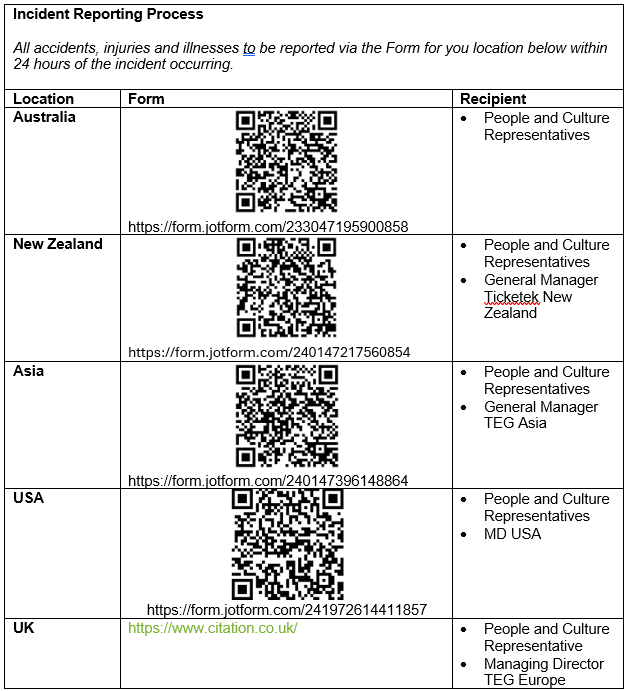
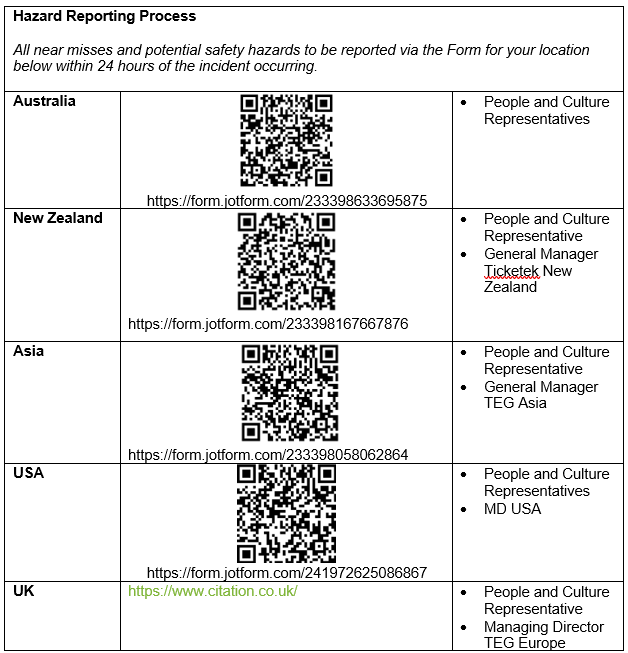
(c) All accidents, injuries, near misses and potential safety hazards (including physical and psychosocial hazards)– including those outside the Workplace that can impact work and Workers – must be reported via the following forms no later than 24 hours.
(d) TEG also requires Workers to notify their manager and a representative from the People and Culture team as soon as reasonably practicable in the event that they experience or witness aggression or violence, bullying or sexual harassment in the workplace.
(e) If an incident occurs on a client, contractor, supplier or venue site, follow the applicable incident response procedure in addition to the TEG reporting and notification process set out in this policy.
Reporting an accident, incident, hazard or near miss is critical even if the injury or illness does not require medical attention.
4. Emergency procedures
In case of an Emergency, follow the instructions of emergency services, taking all reasonable steps to ensure personal safety. At the earliest opportunity report to your manger and notify them of your wellbeing and whereabouts. You should also:
a) follow instructions given by your manager and/or emergency services until safe;
b) where work is being completed on a client/customer site or venue, follow the site Emergency procedures;
c) as far as reasonably possible keep in regular contact with your manager;
d) managers are required to escalate any emergency to the SLT member and a People and Culture representative immediately; and
e) SLT should immediately inform the CEO and CFO of an emergency situation.
For further information please contact the People and Culture team via email peopleandculture@teg.com.au or via phone 02 9266 4380 or follow the emergency/escalation process per the above. For out of hours concerns, please contact +61 2 9266 4380.
5. Travel
Before travelling ensure you have reviewed the current government advisory on your destination and reviewed your itinerary in line with the advice. If there are any concerns about your proposed travel, you should raise them in the first instance with your manager. When travelling:
- internationally, all team members are required to log their travel (e.g. with smarttraveller.gov.au in Australia);
- comply with all travel advice. No staff member should be travelling to any countries where the travel advice is rated a ‘Level 4 – Do not travel’, equivalent or above;
- note your managers mobile number and People & Culture number down in your contacts; and
- if you find yourself in a situation where the local authorities or your manager are not able to assist you, contact the local embassy or consulate for assistance and instruction.
6. Legislation
TEG follow the applicable laws, acts and regulations of the countries in which we operate.
- In Australia, there is Commonwealth and state-based legislation in relation to WHS. All states and territories, except for Victoria, are largely harmonised under the model WHS Act 2012 and WHS Regulations 2012. See Safe Work Australia for reference.
- In New Zealand, there is national coverage from the Health and Safety at Work Act 2015 (HSWA). See Work Safe for reference.
- In Malaysia, there is national legislation provided under the Occupational Safety and Health Act 1994. See Department of Occupational Safety and Health for further information.
- In Singapore, there is national legislation provided under the Workplace Safety and Health Act 2006. See Workplace, Safety and Health Council for further information.
- In the Philippines, there is national legislation provided under the Occupational Safety and Health Standards General Public Act 1989. See Occupational, Safety and Health Standards Commission for further information.
In some jurisdictions (including Australia), it is unlawful to discriminate against or victimise any Worker because the Worker raises an issue or concern about a workplace matter that they consider is not safe or is a risk to health.
This Policy is not a term of any contract, including any contract of employment and does not impose any contractual duties, implied or otherwise, on the TEG. This Policy may be varied by TEG from time to time.
7. Related documents, forms and tools
All WHS forms, procedures, templates and other material can be found on the WHS intranet page.
See the WHS Contractor Checklist for management of contractors.
Online training is provided for employees and managers, on work health and safety responsibilities.
Bullying, harassment and discrimination is a work health and safety issue. More information can be found in the EEO and Respectful Workplace Behaviour Policy.